
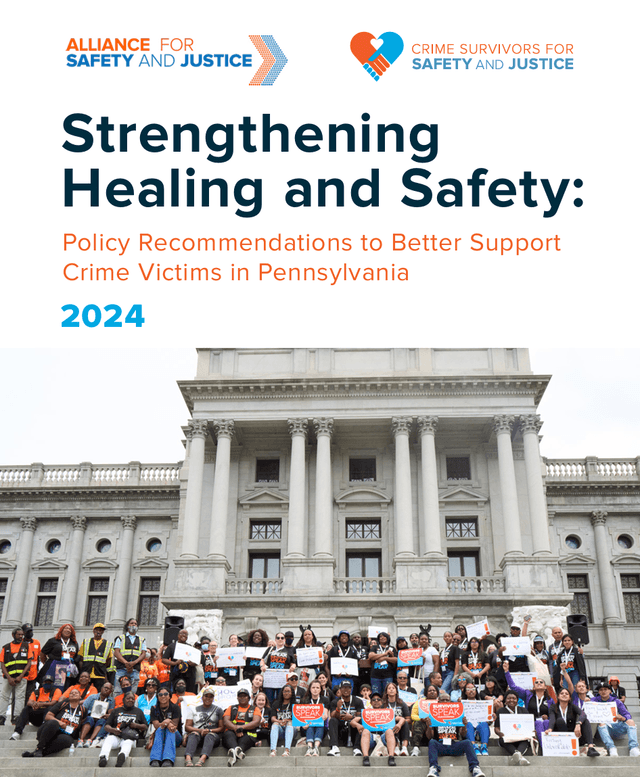
Strengthening Healing and Safety: Policy Recommendations to Better Support Crime Victims in Pennsylvania
For too long, public safety policies haven’t helped victims of crime. The voices and experiences of diverse crime victims have been ignored, despite tremendous increases in public safety spending. It is time that crime victims are valued as the public safety stakeholders they are, with critical insights into what people and communities need to feel and be safe based on their firsthand experience of experiencing harm.
Most victims and survivors want what happened to them to never happen to them or anyone else again, and all victims in the Commonwealth deserve a safety and justice system that works – one that prioritizes healing and recovery from harm, prevention, accountability, and stops cycles of crime.
The following nine policy recommendations present priority solutions needed to advance healing, prevention, safety, and trauma recovery for the people and communities most harmed by crime and violence. This agenda has been informed by the nearly 8,000 Pennsylvania members of Crime Survivors for Safety and Justice, whose voices and experiences must be at the forefront of policymaking to address violence and support victims of crime in the Commonwealth.
Nine key priorities to support victims and promote public safety in Pennsylvania:
Fund Help for Survivors
- Ensure stable funding for victims of violent crime: provide an ongoing appropriation for the Victim Compensation Assistance Program (VCAP)
- Strengthen Pennsylvania’s Victims Compensation Assistance Program So That More Survivors Can Receive the Help They Need.
- Establish and Fund Trauma Recovery Centers to Help Crime Survivors Heal and Access Victims Compensation.
- Improve Access to Funding for Survivor-led Organizations Serving Other Survivors.
Expand Victim Rights
- Ensure Safe and Stable Housing for Survivors Following Victimization.
- Ensure Survivors Can Take Safety and Recovery Leave from Work to Address the Consequences of Their Victimization.
- Protect Survivors Facing Charges or Sentenced in the Criminal Justice System.
Prevent Violence and Promote Rehabilitation
- Stop Cycles of Crime and Victimization by Promoting Prevention, Rehabilitation, and Reentry Support.
- Support Expansion of Clean Slate Laws so People with Old Records Can Have Safe Pathways to Pro-social Connections like Jobs and Housing that Reduce Recidivism.
Fund Help For Survivors:
PRIORITY 1: Ensure stable funding for victims of violent crime – provide an ongoing appropriation for the Victim Compensation and Assistance Program (VCAP):
Victims compensation is an important pathway for survivors to get needed support. Compensation meets immediate and long-term needs by covering expenses including medical bills, funeral and burial costs, relocation, mental healthcare, and support for dependents of homicide victims. Coverage is a lifeline that allows survivors and their loved ones to focus on recovery, and is only available to survivors who have no other means of covering these costs. Like every state, Pennsylvania has a victim compensation program, administered in the Commonwealth under the Pennsylvania Commission on Crime and Delinquency (PCCD).
For too long, the program has faced funding instability and uncertainty that has prevented the state from providing more support to survivors that meets the true need for this program.The Victim Compensation and Assistance Program (VCAP) is funded by a mix of federal matching dollars and state fines and fees on youth and adults in the criminal and juvenile justice systems. Relying on fines and fees for the state component of funding is inherently unstable – and the fund has historically often spent more than it has taken in in a given year, threatening insolvency. Onerous fines and fees also trap people in the justice system in cycles of impossible debt, interfering with community safety goals. Without another more stable source of revenue, the fund will not be able to compensate survivors at current levels – let alone make necessary changes to make the program accessible to more survivors in need.
Policymakers should not defer critical changes necessary to support survivors due to fears about fund solvency – instead, the legislature and administration must act to fully fund the program with general fund dollars at the level of need. Policymakers should also consider adopting the federal funding model – which relies on fines and fees levied on corporations prosecuted for misconduct. Pennsylvania should establish a practice of moving a percentage of settlements with corporations as a source of revenue to fund victim services in the state.
PRIORITY 2: Strengthen Pennsylvania’s Victims Compensation Assistance Program So That More Survivors Can Receive the Help They Need:
While Pennsylvania’s Victim Compensation Assistance Program is in many ways a national leader, and the program has made tremendous strides to remove barriers to help, many survivors in need still struggle to access resources due to restrictive requirements written into law.
In 2022, survivors supported the passage of Act 77, which was a big step forward to make transformative improvements to the program. The legislation included the following, among other provisions:
- Changed unrealistic time limits. Increased the time limit to apply from 2 to 5 years from the victimization date, and allowed exceptions to the 5-year limit if the applicant has good cause for a delay. It also eliminated the 72-hour time limit to report the crime.
- Increased alternative reporting options for survivors of sexual assault. Allowed victims of sexual assault to use an intimidation order instead of a police report, similar to domestic violence survivors. Unfortunately, other survivors are not yet afforded alternative options.
- Expanded eligibility by narrowing laws that require the state to scrutinize the victim’s behavior. Barred denials for counseling costs for any victim or funeral costs for surviving family members of deceased victims based on restrictions that blame the victim for their own victimization. Allowed discretion on whether to reduce or deny any other claim based on the victim’s conduct, rather than requiring denial. Unfortunately, family members of homicide victims and other survivors can still be denied desperately-needed help bearing financial burdens like loss of support and crime scene cleanup based on this subjective criteria.
- Covers more costs. Allowed awards to cover vehicle cleanup, and travel to mental healthcare.
Still, Pennsylvania lawmakers can do more to strengthen the compensation program, and to adopt proven best practices for supporting survivors. Alongside increasing and stabilizing funding for the program to meet the level of actual need, Pennsylvania should consider the following improvements to build on Act 77 and get help to more survivors:
- Revise award caps and expense coverages to cover more of the actual need. Compensation is the payor of last resort - people who receive compensation have no other means to cover these expenses. But current expense caps are decades-old, and fall short of meeting the reality of the costs survivors incur, and Pennsylvania’s expense coverage lags behind most neighboring states. Low caps include:
- Just $500 for crime scene cleanup. Professional crime scene cleanup services commonly range from $2,000 to as much as $20,000.
- $6,500 for funeral costs. The National Funeral Directors Association estimates the median cost of a burial with a vault (required by most cemeteries) is $9,4203—and this does not take into account cemetery or tombstone expenses which likely bring the total cost to well over $10,000.
- $1,000 for relocation costs, significantly lower than the median rent in Pennsylvania.
- Pennsylvania also only covers parents and spouses of deceased victims for 2-weeks of lost wages to grieve - not nearly enough time for immediate family members suffering a violent loss.
- Extend alternative reporting and cooperation options to all survivors. Pennsylvania’s program requires a police report and cooperation with law enforcement before the state can process an application in most cases, with narrow exceptions mainly for survivors of sexual assault and domestic violence.
- A police report is required in most cases even if victims have another form of documentation readily accessible like a medical record that clearly documents their victimization. Nearly 6 in 10 violent crimes – 58% – are not immediately reported to police, making most victims ineligible. Survivors do not report crimes to law enforcement immediately for various reasons, including legitimate fear for their safety. The law restricting PCCD from relying on alternative forms of documentation to verify the victimization can also slow down processing time for survivors to receive help, even when they have reported the crime. PCCD must solicit the report from the law enforcement agency and wait to hear back, which can take weeks, delaying urgent help for survivors.
- Pennsylvania’s law also in most cases requires a determination that the victim has cooperated with law enforcement, a practice a recent AP investigation highlighted creates unnecessary barriers to help. A law enforcement officer may have an impression that a victim is non-cooperative because they say that they do not know who shot them, or because they are not willing to talk in a hospital where there are thin curtains and a fear that the person who harmed them might know that they said something. Research shows that when victims actually get the help they need first, they are more likely to feel safe and able to cooperate with law enforcement to help solve a case.
- Recognizing these issues, a number of states now allow survivors to use alternative forms of documentation to access compensation, and exempt survivors from assessments of cooperativeness. For example, the Louisiana legislature unanimously passed legislation in 2022 which allows victims to submit court records, medical documentation, or a statement from a trained treatment provider to document the victimization. New Mexico, New York, Oregon, and Illinois have also passed similar legislation in recent years, joining several other states.
- Improve emergency awards. Currently, survivors must wait months after submitting an application before finding out if critical costs will be covered. Pennsylvania statute and rules allow for “emergency awards” where the need is more urgent, and Act 77 also removed the cap on the amount the Office of Victim Services at PCCD could offer in emergency awards. But emergency awards for funeral or medical costs can counterintuitively only be issued to cover expenses that the victim has already paid – most survivors do not have the funds to afford these expenses, which is why they are seeking compensation and need an emergency award. Relocation and crime scene cleanup are also ineligible for emergency awards, despite the urgent nature of these expenses.
- Prevent predatory and harassing debt collection while a victim’s claim is pending. A survivor’s bills can pile up while waiting to have a victim compensation application approved. As of publishing of this report, there is no law restricting aggressive debt collection practices or referrals to collections from medical providers or funeral homes during this period, even if ultimately the victim is found eligible for state funds to pay for an expense. Debt collection practices can cause long term financial consequences for victims waiting for help, and add unnecessary stress in the aftermath of trauma.
- Eliminate laws that require the program to scrutinize victim behavior and that retraumatize survivors. Pennsylvania law allows help to be denied for most covered expenses on the basis of allegations that the victim’s behavior contributed to the crime - even if it is affirmed that the victim did not commit the crime and was not an accomplice, and regardless of whether the case has been solved. These determinations are often informed by the initial impressions of law enforcement, and are susceptible to biases and judgments based on a survivor’s past interactions with the justice system. National data show that as a result of these types of policies, Black victims and their families seeking help are disproportionately denied.10 Act 77 (2022) made significant progress on this issue - ensuring this exclusion is not used to deny family members of homicide victims help to bury their loved one, or any survivor help paying for mental health counseling. But, loved ones of homicide victims may still be denied help for other costs like crime scene cleanup or loss of support. And, living victims may not be able to get help to relocate or with other urgent needs that help create stability following trauma. Requiring the state to conduct these types of assessments can also slow down processing times for survivors whose claims are ultimately approved – delaying critical support.
- Ensure state grants to victim services providers allow providers to assist victims directly with emergency expenses, or establish emergency funds. The Victim Compensation Assistance Program is critical, but due to barriers in state and federal law, not every survivor can access funds. For those who can access compensation, the program often falls short of covering the full need, or does not get funds to survivors quickly enough. Local immediate needs funds – ideally based in trusted community organizations rooted in communities most harmed – can supplement the Victim Compensation Program and flexibly serve survivors who are most harmed and least supported.
PRIORITY 3: Establish and Fund Trauma Recovery Centers to Help Crime Survivors Heal:
Trauma Recovery Centers (TRCs) deliver a transformational new model of care for survivors of violent crime to address the challenges they face after experiencing violence. This evidence-based and nationally-recognized model helps survivors of violent crime who face barriers accessing traditional victim services heal and recover from the effects of trauma. Early intervention and support for survivors of violent crime can help victims deal with the immediate consequences of trauma and prevent long-term negative consequences that affect all of us. There are now 52 TRCs nationwide, but just one TRC in Pennsylvania located in Harrisburg. Growing the TRC network in the commonwealth is key to ensure that underserved victims of crime have access to the care and services they need.
The TRC model includes assertive outreach to identify and engage the hardest-to-reach victims of crime, clinical case management to target a survivor’s multiple needs (medical, legal, financial, and others), and evidence-based psychotherapy to address trauma at no cost to the client. TRCs are staffed by a team that may include psychiatrists, psychologists, social workers, and outreach workers that are equipped to serve a diverse client base. Assertive outreach breaks down the barrier of the office visit by engaging clients in the community, including in their homes, while TRC clinicians provide a single point of contact for all services. A flexible, coordinated, trauma-informed approach allows clinicians to tailor services to patients’ individual needs, providing victims of crime with the services and supports that are most important to them while eliminating the barriers to treatment that often prevent patients from accessing traditional services.
An evaluation of the Trauma Recovery Center model found a range of improved outcomes for victims, including:
- A 69% increase in police reports filed.
- A 56% increase in return to employment for participants.
- 87% increase in access to mental health services compared with usual care.
- 95% of TRC participants reported feeling better emotionally.
- 93% reported improvements in day-to-day functioning.
- 90% reported improvements in relationships with family & friends
A recent national survey of TRCs found that they are meeting their goal of providing vital services to underserved survivors who face multiple barriers to care. TRC clients are disproportionately people of color, low income or unemployed, have limited or no English proficiency, are unhoused or unstably housed, and are dealing with a variety of mental health challenges. The most common victimization experiences among TRC clients include domestic violence, physical assault, sexual assault, and gun violence. The survey also found that TRCs are filling existing gaps in the victim services landscape and coordinating care with other service organizations.
Pennsylvania must invest in growing TRCs to serve victims throughout the Commonwealth. The one existing TRC in Pennsylvania does not receive state funding, unlike most of the 52 Trauma Recovery Centers in other states. Victims in other parts of the state have no access to TRC services, and too many Pennsylvania victims have nowhere to turn to for help. Pennsylvania must establish a network of TRCs to serve victims across the state, and create a dedicated state funding stream for TRCs to ensure continuity and stability of services.
PRIORITY 4: Improve Access to Funding for Community-Based Organizations Providing Peer-to-Peer Support for Survivors:
Federal VOCA funding is currently the largest source of funding for victim services, granting the state funding that the Pennsylvania Commission on Crime and Delinquency (PCCD) then redistributes to local service providers. But due to declining revenue into the federal Crime Victims Fund, states are facing a 40% cut to VOCA funding – which could devastate access to support for victims in Pennsylvania. The state must act to fill this gap, and in doing so use this as an opportunity to create new funding streams that are more accessible to frontline victim services providers.
Crime Survivors Speak works alongside dozens of frontline organizations across Pennsylvania led by survivors, most of whom began responding to violence out of necessity, finding no support when they themselves experienced crime.
These organizations and others like them are intimately knowledgeable about their communities, and have the expertise and credibility to address the needs of victims who have been left out of traditional clinical or criminal justice-system based services or who may be wary of engaging with traditional service providers.
But many of these organizations have never received Victims of Crime Act (VOCA) or other government grant dollars, even though they are the trusted first responders in their communities when violence happens. They often do not have existing funds to hire grant writers or deal with overly bureaucratic requirements.
When these organizations do not get the resources they need, survivors often have nowhere to turn for help. Unresolved trauma can lead to someone becoming a victim again and fuel cycles of harm, with costly long-term consequences for individuals, families, and the community. Nearly two thirds of violent crime victims report experiencing repeat victimization. Making sure victims have what they need to stabilize and heal following crime is essential to reducing violence and improving safety.
PCCD has shown in its recent approach to Violence Intervention and Prevention (VIP) funding that it is possible to make grant funding more accessible and available to smaller frontline providers that have not previously received funding. To respond to the increase in VIP funding available in 2022-23, PCCD developed an innovative tiered model for distributing funds, to ensure “micro organizations” doing frontline neighborhood-based intervention work would be eligible and have access.16 The agency also created a more accessible application process, and shared helpful resources on its website to help organizations apply. This is responsive to community-based organizations on the frontlines - and these funds were comprehensive, and included some funding for trauma recovery services. Pennsylvania awarded another $40 million in VIP funding in FY 202324, and recognizing the need for and promise of this funding, the Governor’s proposed 2025 budget includes $100 million to fund these programs. The state should approve the $100 million allocation for the VIP program, and continue to increase funding for this lifesaving work. The state should also fund PCCD to replicate this approach with grants that are dedicated to providing victim services, as follows:
- Cut the red tape that makes grant funding inaccessible to frontline community-based organizations. Overly stringent requirements box out trusted providers, who need to be able to work nimbly to meet emerging needs on the ground, and creatively to provide services tailored to survivors in their communities. These groups often do not have the resources to hire grant writers, or time to comply with unnecessarily specific and burdensome reporting requirements while working to respond to community members in crisis. To ensure resources get to these organizations, Pennsylvania should:
- Accompany grant programs with robust technical assistance for applicants geared to support organizations that have not applied for or received state funding in the past.
- Design RFPs with local providers in mind, and developed in conversation with providers based in communities most harmed by violence. PCCD can build on the RFP and application approach it implemented for VIP grants, which ensured an accessible application process via Survey Monkey and supportive resources to help new organizations that apply.
- Allow for flexibility and accessibility in grant programs, including significant funding for general operating costs, with trust in those whom survivors call on first for help.
- Fill the state’s gap in available federal funding, and create an additional dedicated funding stream for smaller frontline victim services providers rooted in communities most harmed by violence
- Increase general fund spending on victim services to backfill federal gaps. VOCA funding has declined significantly in recent years, and the state needs to step up to ensure stability for providers already receiving funds, and to expand funding for frontline organizations that have not received funding in the past.
- Allocate general fund dollars toward a grant program dedicated to victim services providers rooted in communities most harmed by violence that have smaller operating budgets or that have not received state funding in the past.
- Expand on PCCD’s innovative approach to distributing CVI/VIP funding to other grant programs, and implement a competitive tiered model for distributing victim services grant funding so that small budget organizations compete in a separate category from larger organizations. Include robust technical assistance that supports smaller organizations to scale up and eventually apply for larger grants.
Expand Victim Rights
PRIORITY 5: Ensure Safe and Stable Housing for Survivors Following Victimization:
After violent victimization, survivors and their family members may need flexibility related to their housing situation to increase their physical safety and emotional wellbeing. For example, they may need to break a lease to relocate or change their locks to stay safe. Staying in the home may compound a survivor’s trauma, or expose the survivor and their family to further violence.
Victimization can also increase vulnerability to eviction, with tenants evicted on the basis of acts committed against them. Studies show that these kinds of practices have disproportionately been used against tenants of color in low-income communities.
The Alliance for Safety and Justice recently conducted a representative national poll of survivors and found:
- Nearly half of violent crime victims wanted to relocate after the crime, but fewer than half of those were able to.
- More than a quarter of violent crime victims feared being forced out of their homes or were evicted after being victimized.
Pennsylvania is falling behind other states in keeping victims safely housed:
- At least 40 states have statewide protections to ensure that certain victims are able to terminate a lease without penalty, if they need to relocate quickly following violence.
- At least 38 states have laws that protect tenants who are victims of some forms of violence from being evicted because of their victimization, and 19 states have laws allowing survivors who are tenants to change their locks for their safety.
Pennsylvania currently has no parallel statewide protections. The legislature did pass SB 919 in 2018, which provided some relocation help to domestic violence and sexual assault survivors, but only those who are tenants of a county housing authority and need to relocate. This legislation also only mirrored existing federal statute at the time, and is now out of step with more protective federal law for survivors living in public housing. Pennsylvania law also bars municipalities from enacting policies that penalize landlords who do not evict tenants who make calls for emergency services. And certain jurisdictions have passed local ordinances that provide protections to tenants living in those jurisdictions - Philadelphia, for example, allows domestic violence or sexual assault survivors to terminate a lease early and protects survivors from eviction due to their victimization.
But survivors of other types of violence like gun violence are not covered by these local protections. Most survivors of violence in the state have no protection if they need to end a lease early and relocate, and risk losing a security deposit and damaging their future financial stability. Survivors also have little recourse if they are evicted as a result of their own victimization. Pennsylvania must adopt comprehensive housing protections for survivors of violence.
PRIORITY 6: Ensure Survivors Can Take Safety and Recovery Leave from Work to Address the Consequences of Their Victimization:
No employee who has been a victim of a violent crime should have to choose between their physical or emotional safety and their job. Financial insecurity and other life stressors following a crime are among the factors that can increase a victim’s risk of developing Post Traumatic Stress Disorder (PTSD), and can have lasting impacts on both victims and their employers. In a representative national poll of survivors, the Alliance for Safety and Justice found that 1 in 6 victims of violent crime (16%) lost a job or were demoted after taking time off work to recover.
Existing Pennsylvania law recognizes the state’s role in protecting the economic security of crime victims who need to take time off from work, but only in limited circumstances. Victims or witnesses who need to take time off from work to attend court cannot be fired from their job, but this protection does not apply when survivors are attending to other critical needs.
The state’s victim compensation law also steps in to provide for some limited loss of earnings when victims or their family members have to miss work to heal and recover, but under current law, victims of violent crime can still be fired if they need to take time off, whether to relocate for their safety, access medical or mental healthcare for harms related to their victimization, obtain services from a victim services provider, or attend the funeral of a family member who was killed in a homicide. To fill the gaps in the state’s current approach, Pennsylvania needs legislation to complete these protections by ensuring victims of violent crime can take protected and paid time off from work if they need to meet critical recovery, safety, and legal needs after victimization.
At least 25 states have laws to ensure that certain survivors can take leave from work following a violent crime to recover or to make plans for safety without fear of losing their jobs and economic security. While some localities in Pennsylvania have ordinances allowing employees who are victims of certain crimes to take time off from work without losing their jobs, the Pennsylvania legislature has not acted to provide these protections to survivors statewide. And, existing local protections only cover certain groups of survivors. The legislature must act to ensure Pennsylvania survivors do not lose their livelihoods when they take time off for urgent safety and recovery needs, and have the safety accommodations they need in the workplace.
PRIORITY 7: Protect Survivors Facing Charges or Sentenced in the Criminal Justice System:
Experiences of violence and trauma can lead to subsequent contact with the justice system. For example, survivors who act in self-defense from ongoing violence, are forced by abusers to engage in illegal activity, or use substances as a part of an abusive dynamic may face arrests or convictions as a result of their victimization.26 Many states are establishing and expanding protections to ensure courts have opportunities to consider evidence about abuse or violence where it is relevant at different stages in a criminal case. These include opportunities for diversion from prosecution for survivors, the ability for survivors to raise their experiences as an affirmative defense where the offense was directly related to victimization, sentencing structures that allow courts to take prior trauma into account in decision making, and record relief eligibility for survivors with records resulting from their victimization. Pennsylvania has established some procedural protections for survivors navigating the criminal justice system after victimization, but more progress is needed.
- Expand diversion and affirmative defense opportunities for survivors. Survivors who are arrested or charged in direct relation to their victimization experience need opportunities to heal from trauma, rather than prosecution or punishment. The ability to access diversion pathways before being charged, and assert affirmative defense during court proceedings, gives survivors opportunities to present evidence for law enforcement or courts to consider regarding the connection between their actions and their violent victimization experience. Current Pennsylvania law gives some trafficking victims who are arrested for specific low level offenses priority for pretrial diversion. Trafficking survivors can also raise an affirmative defense, but only when charged with prostitution-related offenses, not when facing charges for other offenses resulting from their victimization. Far too many survivors are left behind.
- Articulate specific sentencing mitigation structures for survivors. A growing number of states are passing sentencing mitigation laws for survivors who are or have been convicted for offenses tied to their victimization experience. Some laws create mechanisms for judges to reduce the severity of the punishment at sentencing, while others allow survivors who have already been sentenced to petition for resentencing or release consideration. Pennsylvania could follow suit to ensure that survivors convicted of offenses stemming from violent victimization experiences have the opportunity to be considered for appropriate sentencing adjustments and relief.
- Strengthen record relief pathways for survivors of violence. Research shows that many survivors have a criminal record as a result of their victimization. Having a criminal record can prevent survivors from accessing safe and stable housing, securing employment, caring for children and other loved ones, furthering their education, and obtaining care and resources that help them to recover and attain stability in the wake of their victimization. The vast majority of states, including Pennsylvania, recognize that survivors need some access to criminal record relief for offenses related to their victimization. Pennsylvania’s protections, however, are extremely limited in both eligibility for relief and the type of offenses that can be cleared. Expanding pathways for record relief survivors in Pennsylvania will allow them to overcome the many barriers associated with a criminal record so that they can begin to heal and move on with their lives.
Prevent Violence And Promote Rehabilitation
PRIORITY 8: Stop Cycles of Crime and Victimization by Promoting Prevention, Rehabilitation, and Reentry Support. Survivors overwhelmingly support promoting violence prevention and investing in care and essential services so violence doesn’t happen in the first place. A 2022 survey found that by a 2 to 1 margin, victims prefer investing in crime prevention, crisis assistance, and strong communities over increasing arrests, punishment, and incarceration. Survivors name mental health care and substance use treatment, and violence prevention as the top two public safety investment priorities. Research supports using a wide range of community-based strategies to prevent and reduce violence, and a stronger infrastructure of community organizations is directly related to lower crime rates, particularly for murder and violent crime. Investing in local community prevention and supports can improve public safety while also avoiding the many negative outcomes associated with overreliance on the criminal legal system, which can include increased recidivism, lower workforce engagement and economic mobility, higher levels of retraumatization, worse health outcomes, and a wide variety of family- and community- level burdens.
For people who are in the criminal justice system, survivors support focusing on rehabilitation so that people who have caused harm in the past are less likely to cause harm again. By a 2 to 1 margin, survivors want the criminal justice system to focus more on rehabilitating people who commit crimes than on punishing them. Studies have consistently shown that providing opportunities for rehabilitation reduces crime and improves long-term public safety outcomes Reducing revictimization requires ensuring that people who are in the criminal justice system because they have harmed others gain the skills and tools necessary to be successful after their contact with the system is over. There are many opportunities to strengthen pathways to rehabilitation, including 1) as part of front end programs at the local level, 2) during incarceration and community supervision sentences, and 3) as part of the reentry process.
Pennsylvania has several local-level rehabilitative structures in place to provide behavioral health treatment for people engaged in the criminal justice system. For example, the Accelerated Rehabilitative Disposition (ARD) program is designed to connect people with first time offenses with treatment and rehabilitation support to prevent additional crime and criminal justice system contact. Programs such as these can connect people who are engaged in harmful behavior with appropriate treatment and programming, and offer them pathways to take responsibility for addressing underlying issues connected to their behavior. Reducing burdens on courts and other local criminal justice system agencies can also increase efficiency in public safety spending, which can be used to advance crime prevention and other important public safety goals.
The public safety benefits of providing meaningful access to rehabilitative programming during incarceration are also well-documented in the literature. In Pennsylvania, participation in correctional education was found to reduce the odds of rearrest, and people who participated in multiple programs had the best public safety outcomes. Studies demonstrate that programming is most effective when paired with strong incentives for participation, such as earned sentencing credits. Incentives can be powerful tools to prepare people for release by enhancing individual motivation to complete treatment and engage in positive behavioral change. Allowing people who are active participants in their own rehabilitation to reduce the time they spend in the criminal justice system can incentivize them to gain the support they need to be successful when they return to their communities. This approach, which is supported by the majority of crime victims as well as four in five likely voters, can promote more efficient public safety spending, freeing up resources that can be redeployed to crime prevention and reentry support strategies.
Finally, ensuring that people exiting prisons and jails have sufficient reentry support is a proven strategy to reduce reoffending and prevent future returns to incarceration. People who are exiting prisons and jails often confront structural barriers to employment, healthcare, and housing, all of which provide critical stability that helps them succeed and reduces the likelihood they will return to the criminal justice system in the future. Providing strong wraparound reentry support can reduce victimization by putting people who are returning home on a pathway to success. Organizations that are closest to and most reflective of communities they serve are uniquely positioned to deliver critical services that support those returning from incarceration. Investing public resources in community based providers can increase their capacity to provide needed services, and can help improve corrections processes and advance public safety goals.
Pennsylvania should consider the following policy strategies to strengthen opportunities for rehabilitation in order to increase public safety and reduce victimization:
- Support local-level opportunities for community-based prevention and care. Ensuring that state policy structures provide opportunities for local innovation related to prevention and diversion, and providing sufficient resources to meet local public safey programming and service needs, can advance this goal. Ensuring that there is a robust local infrastructure for violence prevention, healthcare provision, and community wellbeing outside the criminal justice system is an essential component of violence prevention.
- Ensure sufficient access to rehabilitative programs in correctional facilities and for people on supervision, and pair programming with incentives to be considered for early release or termination. Offering a wide range of programs and other opportunities to engage in rehabilitative activities for people in prison and on community supervision can increase public safety by helping them gain the skills and tools to be successful when they finish their sentences. Policy approaches such as earned credits that allow courts and the parole board to evaluate readiness for supervision termination or prison release earlier can promote more efficient use of public safety resources, and strengthen incentives to complete needed recidivism-reduction programming.
- Strengthen rehabilitative reentry supports for people who are returning home from incarceration. This can include policies to avoid interruption in health care provision for people who are exiting correctional facilities, to release people with necessary forms of identification and documentation, and to facilitate coordination among community-based reentry service providers. Ensuring that local reentry providers have resources and capacity to meet the needs of people coming home to their communities is also critical to preventing recidivism.
PRIORITY 9: Support Expansion of Clean Slate Laws so People Can Have Safe Pathways to Pro-social Connections like Jobs and Housing that Reduce Recidivism:
Pennsylvania pioneered changes to its record clearing laws with Clean Slate legislation. Crime victims overwhelmingly believe that excluding people with old criminal records from the job market, housing opportunities, or from participating fully in their communities jeopardizes safety. Connections to steady employment, safe housing, healthcare, and being able to provide for one’s family are all things that make us safer. Criminal records can create a significant barrier to employment for people coming back to their communities after incarceration.
Strengthening pathways for people to clear old records will improve their ability to engage in the workforce and successfully support themselves and their families. Sealing records produces positive results for individuals and society. The most extensive study of the outcomes of record sealing, published in 2020 in the Harvard Law Review, found a 23% improvement in substantive employment two years after record sealing and a 23% increase in wages. Pennsylvania’s Clean Slate policy created a pathway to address the barriers of a prior criminal record, and the Commonwealth can build on this strong foundation to expand record relief moving forward.
Conclusion
All people in the Commonwealth of Pennsylvania who have been harmed by violence deserve access to safety and healing, and public safety policy that breaks cycles of crime by prioritizing prevention and rehabilitation. This policy agenda provides a roadmap for policymakers and advocates to continue to strengthen protections and supports for survivors, and advance research-backed safety policies proven to stop victimization and make all communities safer.


